
Here are seven simple ways to develop your finger strength and dexterity and so improve your piano playing technique.
1. Keys
Playing on different types of keyboard instrument can develop different playing technique.
Playing an acoustic piano or a realistic digital equivalent will develop greater finger strength, as it takes greater effort to depress each key.
It can also help in playing notes evenly, particularly quietly, due to its wide dynamic volume range.
Playing a synthesiser keyboard can develop playing speed, because the keys are lighter. It can also improve accuracy as you may need to be more careful not to depress notes inadvertently.
2. Scales
The bane of every music student? Scales and arpeggios are boring, but they work.
Not only do they help to reinforce knowledge of the notes in each key signature, but they help develop finger strength and rhythm.
Try playing major, minor and chromatic scales, and major and minor arpeggios, both single-handed and in unison in a variety of ways:
- legato (notes smooth);
- staccato (notes played shortly and sharply);
- regular rhythm;
- alternative rhythm (for example, hold the first note of each octave for longer than the other six notes);
- alternative accents (for example, every third or fourth note);
- inverted (same start note, right hand plays ascending notes whilst left hand plays descending notes, and vice-versa).
Remember to use the correct fingering for maximum benefit.
Other features you may enjoy
3. Stretches
- Play two notes of at least an octave apart, with thumb and fifth finger.
- Play a third note somewhere in between, with another finger.
- Jump staccato from the lower to the higher note and back.
- Hold thumb down on one note and play ascending staccato notes as far as possible with one of your fingers.
4. Work your weaker hand
Many pianists have one hand that is weaker than the other.
Since I stopped playing classical music regularly, my left hand is weaker and less dexterous than my right.
Scales (see above) will help, as will practising parts usually played by your stronger hand.
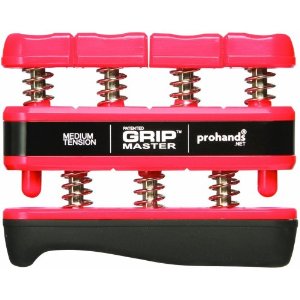
If you’re looking for a product to help strengthen your hands and fingers while away from the keyboard, check out the Gripmaster series. Available in a range of different tensions, they really help to work out the fingers, hands, wrist and arm muscles, improving strength and stamina abilities for any instrumentalist.
 or
or 
5. Work your weaker fingers
Generally, the little (fifth) finger is weaker than the other fingers in the hand (and the thumb is the strongest).
Significantly differing finger strengths will make it difficult to maintain even playing.
- Practice playing scales with even volume across all fingers.
- Play two alternating notes with your weakest finger and a stronger finger. Maintain an even rhythm and volume.
- Play a run of three notes with your weakest finger and two stronger fingers. Again, maintain even rhythm and volume.
6. Styles
Learning to play music in a style that you are not used to can not only be fun, and improve your overall knowledge and musicianship, but it can also highlight areas where your fingers and hands are weaker or less agile.
It can take quite different technique to play classical music well, compared to rock, pop, jazz or blues, for example.
Try learning some music written in a different style, even just a portion or a phrase.
7. Key and Tempo
Try playing pieces or phrases of music you know well at different speeds and in different keys.
- Dexterity can be challenged at faster tempos.
- Steady rhythm can be challenged as tempos change.
- Different fingers can be stretched and strengthened as a piece of music is played in a new key.
Practice these techniques on a regular basis and maintain your playing technique, strength and agility.





22 thoughts on “7 Easy Ways to Improve your Piano-playing Strength and Dexterity”
Other scales very useful to practice not only for dexterity, but for improvisation and composing are the pentatonic scales, and the melodic and harmonic minor scales.