Just past the year since UDO launched the DMNO synth comes the DMNO ON, a compact sans-keyboard synth ideal for desktop use if you already have plenty of keyboards to control it.
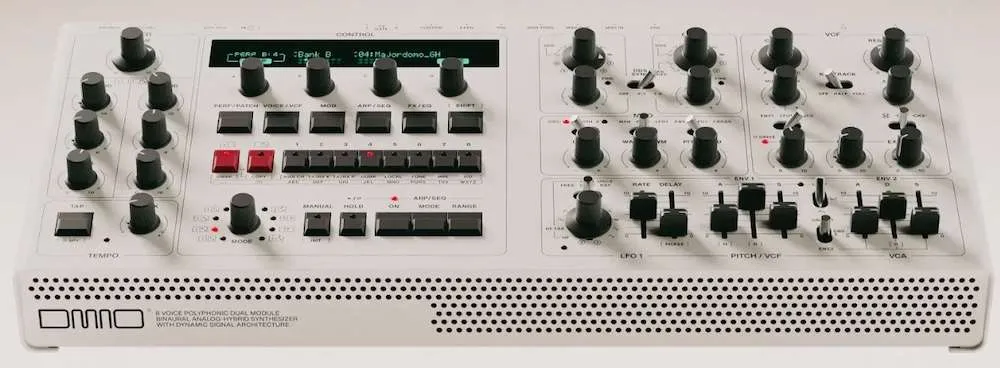
Like its bigger sibling, it’s an 8-voice, 2-part multitimbral synth built around two independent analog-hybrid synth engines. It keeps the highly flexible signal architecture, with each engine featuring the Dynamic Multi-Core Stereo VCF.
Eight creative play modes unlock dynamic interactions between the two timbres at the touch of a single control.
The eight play modes are still in place: single, dual, split, one-two, rotate, random, chaos and cascade.


The only real omission, due to size constraints, is that you get just one synth control set on the device. If you want two (bringing it in line with the keyboard version) then you need to add the ONM-1 Synth Control extra. Yes, it’s an extra expense but if you want the compactness and don’t care for the dual control, you save space — and you can always add it later if you so choose.
An ONM-2 FX Control add-on unit will also be available in due course, offering control of DMNO’s onboard effects engines, previously only accessible via the onboard display.
Expansion units connect robustly using screw-locking D-Sub cable, and are then plug and play with no additional power supply required.
Specification Overview
- Full-featured UDO DMNO synthesizer in a compact desktop format.
- Expandable control-set via ONM Expander Modules.
- 8 voice polyphonic, with 4 ‘super’ voices when in Binaural mode. Binaural mode gives each channel (ear) a full synthesizer voice with independent detuning and modulation, creating an expansive, rich and texturally wide sound.
- 2-Part Multitimbral, comprising 2 independent hybrid synthesizers.
- 8 selectable ‘Play Modes’ that immediately reconfigure DMNO’s signal flow, redefining how its two independent synth engines interact with one another.
- Dynamic multi-core stereo analog VCF with parallel, series and stereo connection modes — featuring multiple filter modes for each connection type.
- Hybrid architecture: FPGA-based high-resolution digital oscillators paired with an analog signal path and a high-quality DSP effects engine.
- 2-in 2-out 24-bit USB digital audio interface.
- Stereo external audio input with a variable-gain preamplifier, gate level detector, and envelope-follower input to the modulation matrix.
- Stereo auxiliary output that can be assigned to either DMNO 1/2, USB digital audio from the connected host, or the effects send bus.
- Two individual user-assignable CV & gate/clock outputs via 1/8”/3.5mm sockets.
- High quality long-lasting electroluminescent glass vacuum fluorescent display (VFD) with dedicated rotary controls. Designed for immediacy with no deep menus and limited ‘hidden’ controls.
- 32-bit DSP digital effects chain including delay, reverb, EQ, overdrive, distortion and chorus.
Exact pricing and availability to be confirmed.